

Rock'n ' Roll Hall of Fame. A Mixed Bag. Pt. 1: The Museum

I've been sitting on this one for a while. Here is a two-parter, because there are really two Rock and Roll Halls of Fame in my head: the museum in Cleveland and the organization behind it. Part 1 is about the building. Part 2 is about the people running the show. Buckle up.
I've got family in Cleveland, so growing up I was up there a lot. I hit the Rock Hall for the first time right as I was discovering classic rock as a kid, which could not have been better timing. I remember walking in and just thinking, I'm in the presence of greatness! This building downtown, right on the lake, and it's a shrine to all this music I was just falling in love with. At that age, it was everything.
The older I got, though, and the more I learned about how the place actually operates, the harder it's gotten to feel that same magic. There's a lot they could do better. I just don't think they will. (More on that in Part 2.)
I visited this past spring again, and to be fair, the museum itself has gotten better since I was last there. They've done some solid expansions with more interactive things to do. So you could really spend the whole day there if you wanted. There is even a new section that lets you play instruments.
I don't want to totally spoil the whole museum for you, but I'll give you an idea of what you do and don't see.
They had a Paul McCartney exhibit up, to co-release with the documentary Man on the Run. I saw the documentary and thought it was pretty good, and the exhibit did it justice. That part of the visit delivered. Then a Saturday Night Live music exhibit that sounded great on paper. Except it's mostly costumes from music-related sketches, not the actual musicians. Seeing Will Ferrell's cowbell beard from the Blue Öyster Cult sketch in person was cool for a second, but I walked in wanting the artists' stuff and got cast member wardrobe instead.
The low point was the photo of the Pope that Sinéad O'Connor famously tore up on live TV. I stood there for a solid minute just taking it in. This is the photo, the actual moment from one of the most talked-about protests in music TV history. Then I read the fine print. It's a reproduction. I get that the original may not exist anymore, or may not be something they can safely display. But if that's the case, why put up a fake torn photo and let people stand there in awe of something staged? That's the kind of thing that sums up my whole complicated relationship with this place. Just tell me what it actually is.
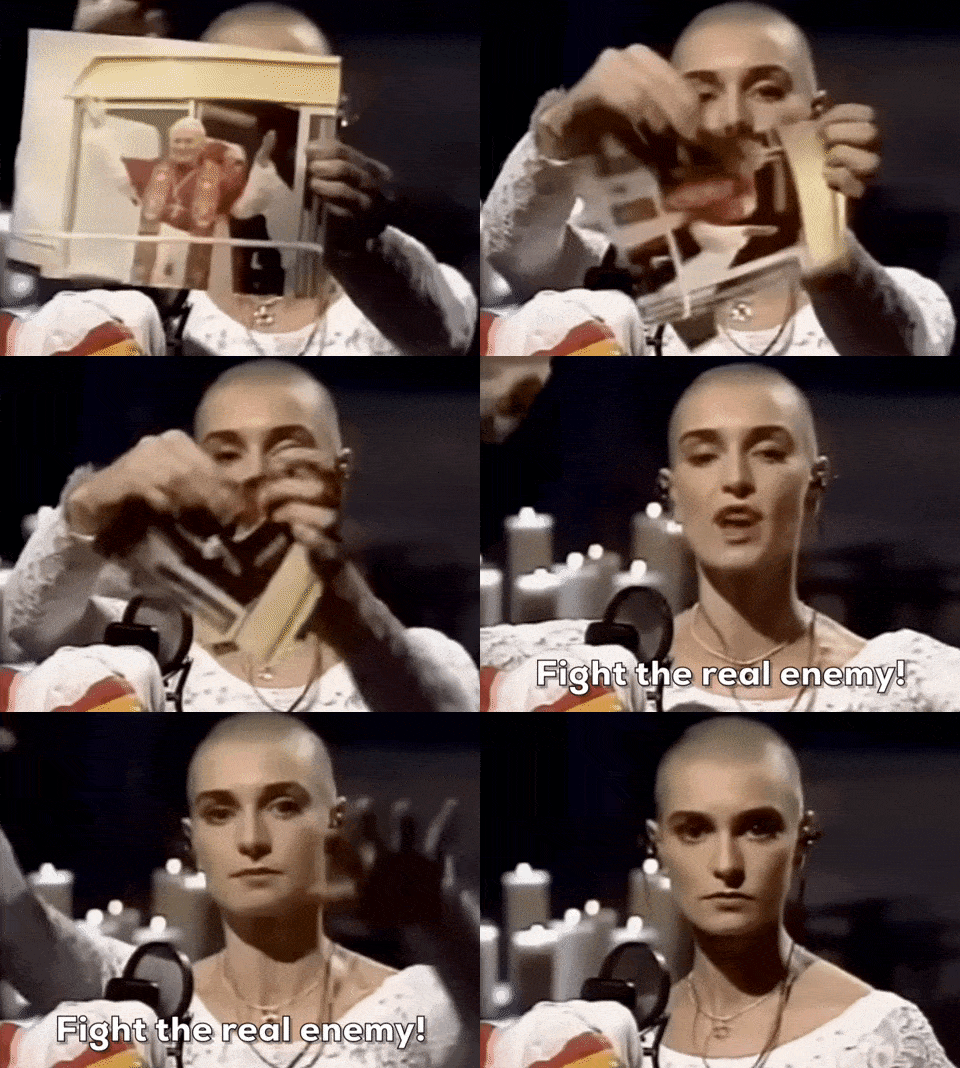
Sinéad O'Connor rips a photo of Pope John Paul II on SNL. 1992
The main collection downstairs is huge, honestly too expansive. The best part, hands down, is the original trailblazers. Muddy Waters, Howlin' Wolf, Little Richard, Chuck Berry. There's even the pair of blue suede shoes down there that's about as "this is what rock and roll is" as it gets.
Then you hit The Beatles, who get an entire wall, and there's just not much memorable on it. A suit, a pair of John Lennon's glasses. For a band that big, the collection should hit harder than that. The Rolling Stones section is even smaller, with nothing that really sticks with you. There's also a big section on the women of rock, which is a great idea, but it's mostly a hallway leading to video rooms rather than actual artifacts. Good concept, thin execution.
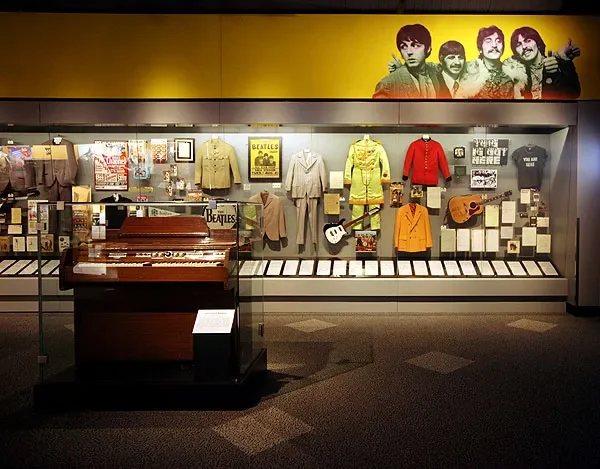
Beatles Wall in the Rock N’ Roll Hall Of Fame
Here's one that bugs me more every time I go. There's no real section dedicated to Cleveland's own artists. This is a museum sitting in Cleveland, in the city where the term "rock and roll" got popularized in the first place, and there's still no proper showcase for the bands that actually came out of here. The Raspberries, Nine Inch Nails, Devo, the James Gang. These are legitimately influential acts with real Cleveland roots, and they get scattered into broader exhibits instead of getting a spotlight of their own.
It goes deeper than the big names, too. Cleveland's soul and funk scene in the '60s and '70s produced real talent that never got its national due. Guys like Lou Ragland, who ran his own independent labels out of the city, backed a young O'Jays before they were famous, and kept that Cleveland sound going for decades. That's exactly the kind of local music history a museum in this city should be telling front and center. Instead, it's basically invisible unless you already know to go looking for it.
This is really where my problem with the "we're running out of rock artists so let's induct hip hop acts" logic comes from. If the well feels dry, the answer isn't to widen the definition of rock and roll until it means nothing. It's to look inward, back into the genre's own deep cuts and regional scenes, and start lifting up the artists who never got their due the first time around.
That's basically the whole model behind Chicago’s Numero Group, the reissue label that's built its reputation on digging up overlooked soul, funk, and rock records and giving them a real second life. They take artists who were basically local legends at best and turn them into names people actively seek out now. That's a genre looking inward the right way, and it's exactly the kind of thing a museum with the Rock Hall's resources and platform could be doing at scale. With the Raspberries and Devo and the James Gang, sure, but especially with someone like Lou Ragland, whose whole career stayed mostly local and underground. Numero Group is the one who gave him his moment, reissuing his album Understand Each Other years later and reintroducing his story to a wider audience. That's what a label with zero institutional weight behind it managed to do. Imagine what the actual Rock and Roll Hall of Fame could do with artists like him if they cared to look.
I've got nothing against hip hop or rap. It's just as important to music history as rock is. But if the Hall wants to broaden the definition that far, at some point just call it the Popular Music Hall of Fame and be honest about it. And hey, you're probably thinking it’s a hall of fame, not anyone who plays rock. Fair point, but maybe it’s time to stop letting acts in then.
Funny enough, the one place that surprised me was the gift shop. The record selection had way more depth than I expected. I found stuff from Sharp Pins, a Chicago artist I didn't expect to see on record in a museum gift shop in Cleveland. It's a small thing, but it made me wonder why that same curatorial curiosity doesn't show up more in the actual exhibits.
That's the museum in a nutshell for me. Real flashes of "this is why I loved this place as a kid," sitting right next to moments that feel like a letdown, or worse, like a bit of a con. I try not to be so negative on the station, but honestly I think a trip to the museum is super fun. The building keeps getting better and is a great start for someone who wants to know the story of how rock n roll got its start and where it’s ended up.
Look for Part 2 next month, where i’ll go into the organization, the ceremony, the voting, and who they've decided does and doesn't belong in "rock and roll" these days. And why none of that work is done in Cleveland.
